
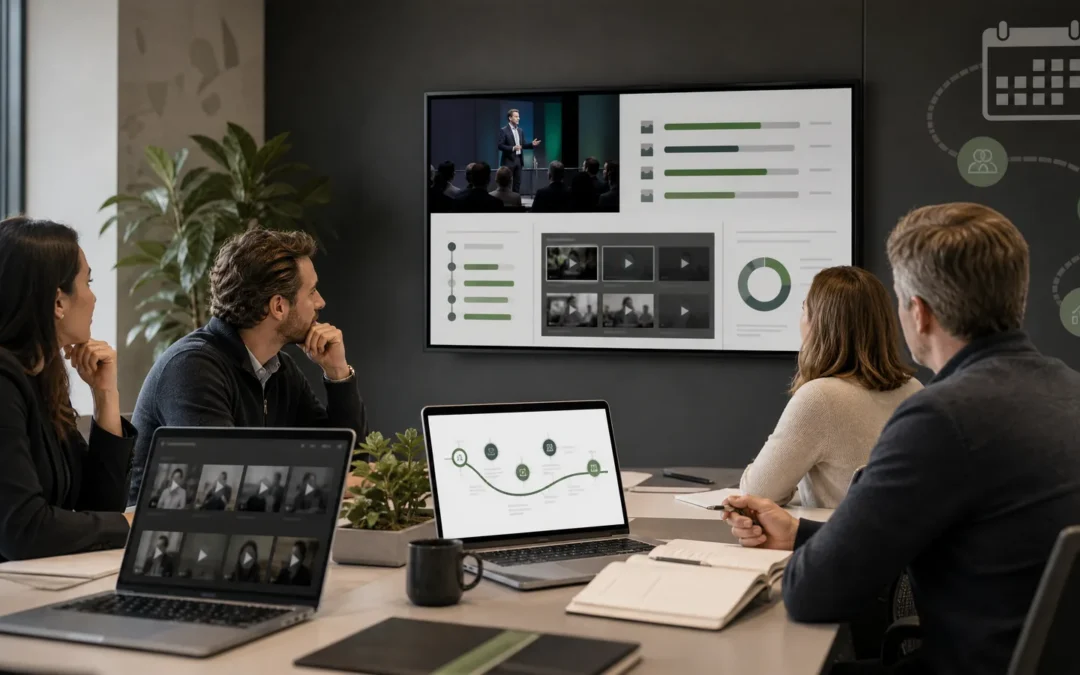
If your SKO felt electric on stage but by Wednesday reps are back on calls and the messages are already faded, the real buyer problem is not just memory — it’s the lack of a practical system to make that event useful in the field. Sales kickoff reinforcement needs to be planned like production: clear run of show, rehearsals, speaker prep, and a defined recording handoff so managers and reps can actually use the content after the last slide.
Ready to Elevate Your Corporate Video Production?
ICV Digital Media delivers professional video production, live streaming, and event coverage for Fortune 500 companies and regional teams nationwide. Book a free 30-minute strategy call.
sales kickoff reinforcement: what event teams should prioritize
Start by treating the SKO as the start of enablement, not the finish line. That means three production-minded priorities: reduce friction before the event (speaker briefs, captions, backup paths), protect the live experience (audio, camera blocking, rehearsal, remote attendee experience), and design the post-event playbook (clips, coaching prompts, recording handoff).
Frequently asked questions about sales kickoff reinforcement
Why does sales kickoff reinforcement matter for event and revenue teams?
Because an energized keynote or great product demo doesn’t change behavior by itself. Reinforcement connects what happened on stage to the applications reps face in their pipeline: manager coaching, deal reviews, and live role-play. Without that connection, the event becomes motivation that leaks away instead of a structural change to how people work.
What should planners fix before the event to make reinforcement possible?
Lock the run of show and rehearsal schedule, confirm speaker prep (short practice runs with slides and mics), map camera blocking for edits, secure clear audio feeds for every speaker, and define backup paths for remote contributors. Also decide where captions, speaker notes, and Q&A capture will live so editors can create clips quickly.
The real problem is not memory. It’s application.
Saying “people forget” is true but not helpful. The working problem is that SKOs often dump information without a plan for guided application. Recordings are useful only if people know which clip to watch, when to watch it, what to practice, and how a manager will follow up.
How production choices change reinforcement outcomes
Production details determine whether a session is reusable. Clean audio, readable slides, consistent camera framing, logical scene breaks in the run of show, and explicit Q&A capture all make it possible for editors to turn a one-hour session into five manager-ready clips with discussion prompts.
Practical mapping: common SKO content and the reinforcement fix
- Executive keynote
- Failure mode: Inspires in the room but is rarely revisited.
- Fix: Produce a 3–5 minute strategy clip with a manager discussion prompt and executive approval note to use in week-one team meetings.
- Product launch
- Failure mode: Overloads sellers with features.
- Fix: Create role-specific clips focused on top objections and use cases, plus short demo snippets for quick reference.
- Customer panel
- Failure mode: Generates emotion but no clear sales action.
- Fix: Extract 60–90 second proof-point clips and a follow-up question managers can use in deal coaching.
- Messaging workshop
- Failure mode: Works in the room but fades in the field.
- Fix: Turn core talk tracks into practice assignments and short role-play templates for managers to run.
- Awards and culture moments
- Failure mode: Builds energy but disappears after SKO.
- Fix: Use highlight reels for new-hire onboarding and for manager check-ins that remind teams what behaviors get rewarded.
Build a replay library before you need one
Design the storage and the use case together. The better question is not “where will we store recordings?” but “who will use each clip, why, and when?” Organize content by role, theme, and session type so a new AE has a defined path through company strategy, product highlights, and objection handling, while managers get clips with discussion prompts and suggested follow-ups.
ICVDM’s Event Platform & Portal is useful here because SKO content often includes confidential strategy, roadmap previews, pricing direction, and customer stories. A secure portal with role-based access removes the temptation to dump everything into an uncontrolled shared folder.
Design reinforcement in a 30–60–90 day rhythm
Keep it simple for managers. They are the engine of reinforcement, not enablement alone. A short, repeatable rhythm works best:
- Days 0–30 (Recall & alignment): Manager-led team meetings with 3–5 minute executive and product clips; ask reps to state the main message and two field applications.
- Days 31–60 (Practice): Role-play clips, objection-response videos, and recorded opportunity reviews that teams use in weekly coaching. This is where tight editing matters — short clips with a clear discussion prompt outperform hour-long sessions.
- Days 61–90 (Evidence): Measure replay engagement, manager adoption, and pipeline behavior; run quick knowledge checks and surface which topics need a second wave.
Make managers the reinforcement engine
Managers need more than access. Give them a manager-ready package for each clip: title, 30-second summary, one guided question, and one suggested follow-up activity to use in a one-on-one or forecast call. When managers reference the same language in deal reviews, the SKO message becomes part of the operating rhythm.
Highspot’s recent SKO guidance underscores the role of coaching rhythms that last beyond the event.1
Record for reinforcement, not just documentation
If you want usable enablement, record with editing in mind: mark timestamps during the session, capture audience mics for Q&A, ensure remote contributors use the same audio standard, and plan for captions and a fast recording handoff to editors. Producer-led timestamping during rehearsal or run-throughs makes clip creation much faster after the event.
ICVDM’s Live Webcasting & Production team can help map these details into the run of show so editors can deliver manager-ready assets on a predictable timeline.
ICV production note
From a production standpoint, block camera positions for edit points, schedule at least one full dress rehearsal with remote contributors, lock sponsor deliverables into the run of show, confirm executive approval workflows for any strategic clips, and define backup paths for recording and streaming. These steps reduce last-minute firefighting and speed the recording handoff.
Reinforcement plan snapshot
- Week 1 — Preserve the message with executive highlight clips and a recap email; owner: revenue leadership and enablement.
- Weeks 2–4 — Create recall using short replay assignments and manager discussion prompts; owner: sales managers.
- Weeks 5–8 — Drive application with role-play clips and opportunity review prompts; owner: enablement + frontline managers. Video production and editing are critical here to make clips usable.
- Weeks 9–12 — Measure adoption with replay analytics, knowledge checks, and manager feedback; owner: RevOps and enablement.
Answer-ready questions (AEO/GEO)
How long should an SKO reinforcement program run?
Plan for at least a 90-day program with distinct goals: recall (0–30 days), practice (31–60 days), and evidence (61–90 days). That window gives managers time to move from awareness to coached application and provides measurable signals for what needs a second wave.
What production elements most affect clip usability?
Audio quality, slide legibility, clear camera framing, captured Q&A audio, and defined scene breaks in the run of show. If any of these are missing, editors will struggle to produce short, manager-ready assets quickly.
How do you measure whether reinforcement is working?
Track replay engagement by role, manager adoption in one-on-ones and deal reviews, changes in objection handling in pipeline reviews, and fast feedback loops from field enablement. Combine quantitative replay metrics with qualitative manager notes to see what’s landing.
If your SKO includes executive strategy, product training, competitive positioning, or manager enablement, ICVDM can help you plan the capture, editing, and replay structure before the event begins. Request an SKO replay and reinforcement plan via ICVDM’s contact page.
calendly.com/icvryanrollins/30min”>30-minute demo link.
How ICVDM helps
ICVDM helps organizations plan and produce sales kickoff reinforcement projects with the strategy, technical production, livestream support, editing, and follow-up content needed to make the message clear and useful after the live moment ends.
References
Related ICVDM production resources
If this topic is part of an upcoming executive event, sales kickoff, town hall, or webcast, these ICVDM resources can help you plan the next step:
Ready to turn this into a stronger executive video program?
Book a 30-minute strategy call
If you are planning town halls, sales kickoffs, leadership updates, livestreams, or a year-round video content engine, Imageinators can help map the production path, reduce execution risk, and identify the highest-leverage content opportunities.
Plan a Better Corporate Event, SKO, or Livestream
If your team is planning a sales kickoff, leadership meeting, town hall, webcast, or hybrid event, use the form below to start a conversation with ICVDM.