
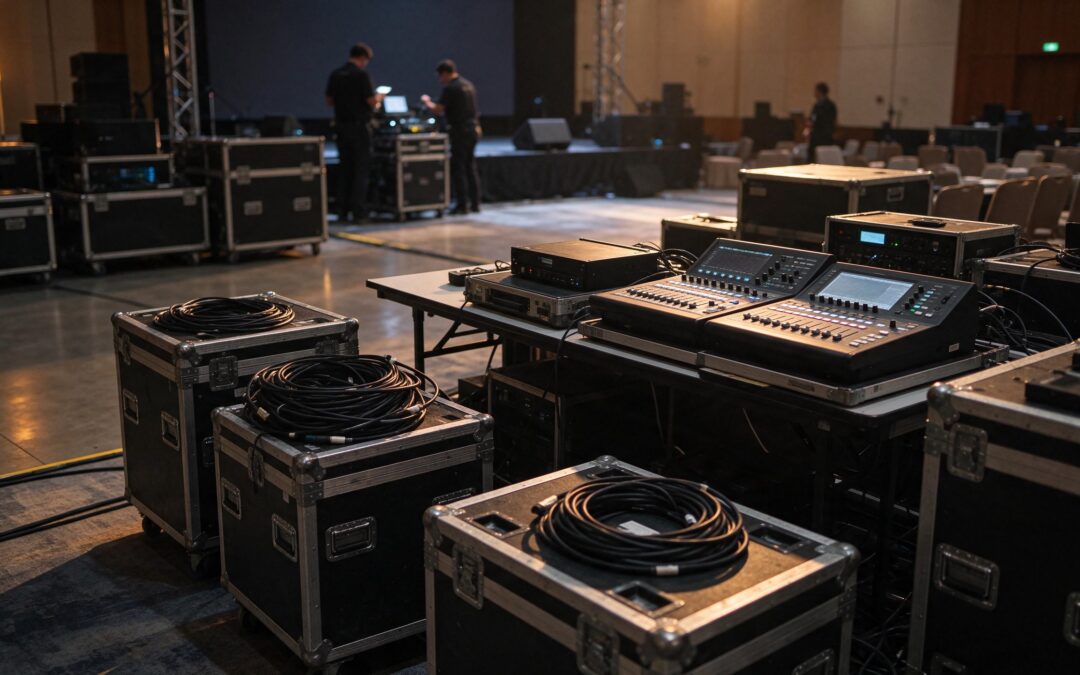
Compare an overnight AV hold with a daily strike and reset as two separate written scopes. Venue permission, room reuse, secure access, equipment remaining in place, reset time and retesting determine which plan is workable. Neither option is automatically cheaper or included in a multi-day production quote.
Can the room remain in the same configuration overnight?
Start with permission, not the equipment list. Ask the venue’s authorized contact whether the specific room and proposed layout may remain in place between sessions. Identify the period covered by that permission, any other room use and the conditions attached. A room booked on consecutive days is not, by itself, a written overnight hold approval.
Describe the proposed configuration precisely enough for the venue to evaluate it. Include the stage area, control position, display locations and equipment outside the main seating area where applicable. Ask whether cleaning, another function or a layout change requires anything to move. These are questions for the actual venue, not assumed rules for Bay Area hotels or conference spaces.
Use three possible decisions: approved hold, required strike/reset, or partial hold. A partial hold means some specified equipment remains while other items move. Mark an unanswered permission request as pending; do not price it as an approved hold. Record who must resolve the decision and when the provider needs that answer to finalize the transition scope.
What stays in place, and what must move?
“Leave the AV overnight” is too broad to approve. Ask the provider to list equipment by function and location, then identify what remains, what is disconnected, what moves to storage and what leaves the venue. A control table that remains in place does not explain whether its computers, microphones or accessories remain with it.
For each moved item, record its destination and who handles the move and return. If an item will serve another room, make that allocation explicit. Ask the provider to identify any proposed substitution and its effect on the agreed presentation, audio or capture requirements. Do not assume that a similar-looking replacement meets the same scope.
Separate physical retention from operating state. Equipment left in position might be shut down, disconnected or otherwise prepared for the overnight period under an agreed plan. Ask the provider and venue to specify the appropriate state and who may change it. This article does not prescribe leaving equipment powered, unattended or connected overnight.
Which quote lines distinguish a hold from a reset?
Keep the next day’s required event function consistent across both proposals. Otherwise, a lower total might simply reflect a different system or less coverage. MeyerPro’s AV quote-comparison guidance recommends aligning scope, setup and strike schedules, equipment assumptions, and labor roles and hours before comparing totals.
For this decision, ask bidders to distinguish equipment rental duration from the work performed each evening and morning. Request identifiable lines or referenced inclusions for overnight retention, strike, storage or handling, return/setup, agreed checks and any access or supervision arrangement required by the actual plan. Name who supplies each service; security is not automatically a production-provider inclusion.
Have each bidder identify crew tasks and coverage windows for the transition. The relevant question is whether the proposed coverage fits the approved access period and leaves time for the agreed checks. This comparison does not assume standard labor days, overtime rules, reset durations or venue charges.
Where an item is bundled, ask where its scope is defined. “Included” should point to a task, period and responsible party. “Not applicable,” “excluded” and “pending” should stay distinct. Compare totals only after unresolved assumptions and differences in next-day readiness are visible.
How do you write a plan for each overnight transition?
Copy this worksheet into your planning document. Complete one instance per room and overnight transition, even if the event uses the same room for several days. Share it with the buyer, venue contact and production provider. It is an original buyer worksheet, not a proprietary method or an ICV operating document.
Comparison assumptions: Both options must support the same agreed next-day program and required configuration. Enter actual access and session times, including the time zone. Blank fields are unresolved, not approved. Prices, technical acceptance criteria and responsibility assignments must come from the parties involved.
Transition identity and permission
- Event / venue / room: ____________________
- Transition from date to date / time zone: ____________________
- Last session ends / room clearance deadline / next room access / next session starts: ____________________
- Selected option: approved hold / strike-reset / partial hold / pending: ____________________
- Venue permission contact / written approval reference / conditions: ____________________
- Other overnight room use / restricted areas / access conditions: ____________________
Equipment, access and responsibility
- Equipment remaining, location and overnight operating state: ____________________
- Items moved, destination and return requirement: ____________________
- Move/return owner / substitutions needing approval: ____________________
- Authorized overnight access / security owner / accepted responsibilities: ____________________
- Room release and morning handoff contacts / escalation contact: ____________________
Hold-versus-reset quote reconciliation
For every row, enter the quoted scope, provider and proposal reference. Use buyer-entered amounts only when actual proposals are available. Add rows for project-specific differences.
| Scope line | Hold option | Reset option |
|---|---|---|
| Equipment duration and availability | ________ | ________ |
| Evening strike or preparation | ________ | ________ |
| Moves, storage and return handling | ________ | ________ |
| Access or required supervision | ________ | ________ |
| Morning reset tasks and crew window | ________ | ________ |
| Test tasks, owner and test window | ________ | ________ |
| Exclusions and pending conditions | ________ | ________ |
Written transition decision
Selected scope / next-day readiness criteria / unresolved items and owners: ____________________
Buyer approval / venue confirmation / provider acceptance / change approver: ____________________
The worksheet is complete when each transition has an accepted configuration, assigned responsibilities, a workable reset/test window and a traceable quote scope. A filled-out worksheet alone does not establish venue permission or provider acceptance.
What does a hypothetical partial-hold plan look like?
Consider a fictional two-day corporate meeting in one Bay Area room. For this illustration only, assume the venue has approved the display and control positions remaining overnight, but has asked for handheld equipment to be removed during cleaning. Those are invented planning conditions, not policies of an actual venue or an ICV client example.
The partial-hold worksheet would name the retained equipment, its agreed overnight state and the items taken to an approved storage location. It would identify the cleaning access arrangement, the security owner who accepts responsibility, and the provider’s return/setup and test windows. If the storage destination or access owner is unresolved, the plan remains pending.
The alternative reset proposal would state what must be removed and rebuilt to deliver the same next-day function. The buyer would compare the actual scopes without inserting assumed savings. If another overnight transition follows, it gets its own worksheet: permission or room use may differ on that night.
What must be confirmed before the next session?
Ask the provider to define checks appropriate to the retained, moved or rebuilt configuration. Depending on the agreed event scope, examples to discuss include microphone operation, presentation playback, display routing and any required recording or webcast path. These are requested checks, not automatic ICV inclusions or a universal technical test standard.
Assign a check owner and specify when access begins, when the reset must finish and when the room must be ready. Record what happens if equipment was moved unexpectedly or access is delayed. The buyer’s authorized approver should receive the proposed scope and timing impact before a change is accepted.
For a wider planning sequence, use the related corporate event production timeline as adjacent context, while setting actual windows for this venue and program. This article addresses only the overnight handoff, not the full event schedule.
ICV Digital Media’s corporate conference production and Bay Area corporate event production pages describe relevant service categories. Bring dates, room-use schedules, venue permission and both transition scopes to a production discussion. Confirm available services, responsibilities and commercial terms in writing; a discussion does not confirm price, availability or delivery.
What else do buyers ask about overnight AV?
Is keeping AV in place overnight always less expensive?
No. Compare equipment duration, overnight arrangements, moves, reset work and testing in actual written quotes. Neither option is automatically cheaper.
Who decides whether equipment can remain in the room?
Obtain the decision from the venue’s authorized contact under the applicable event agreement. Record the permitted configuration, access conditions and responsibilities in the transition plan.
Can some equipment stay while other items are removed?
A partial hold can be proposed, but it needs approval. List retained equipment, moved items, destinations, handling owners and the return/setup and test windows.
Does an overnight hold eliminate the next day’s testing?
No. Ask the provider to define checks for the agreed configuration and any overnight changes. Keeping equipment in position is not proof that the next session is ready.
Do we need a plan for every night of a multi-day event?
Yes. Complete a plan for each room and overnight transition. Reuse confirmed details where appropriate, but check permission, room use, access and next-day requirements for each night.
Sources and editorial notes
ICV Digital Media buyer guide, prepared with AI-assisted research and drafting. Worksheets and labeled examples are original editorial aids, not client records or technical certifications. Confirm project-specific requirements in the agreed production scope.