
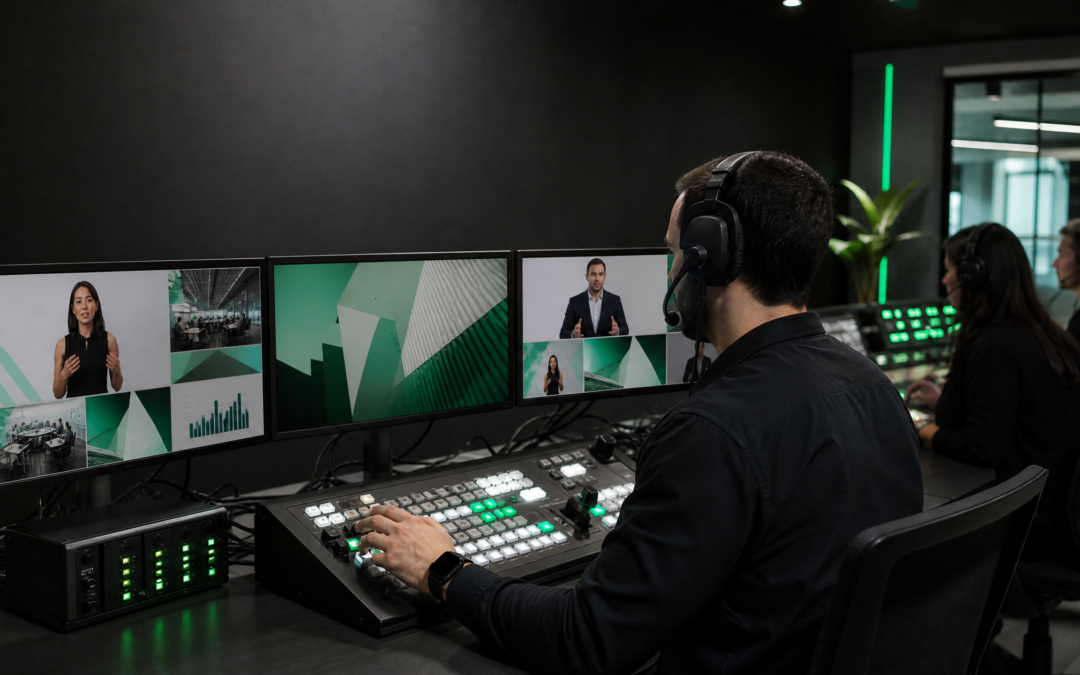
Live Streaming Solutions for Enterprise require planning across technical, security, operational, and stakeholder domains to succeed at scale. Corporate teams must define audience profiles and delivery expectations, then translate those into bandwidth, encoding, CDN, and platform requirements. Early decisions about security, access control, and compliance drive platform choice and latency trade-offs. Production workflows—roles for producers, directors, engineers, and comms—need defined handoffs and testing windows. Budget lines should cover redundancy, monitoring, and recorded capture for repurposing. This article focuses on practical planning and coordination steps for internal comms, marketing, and event-production teams that manage large-scale corporate streams across multiple sites and distributed audiences.
In This Guide
- Live Streaming Solutions for Enterprise: security and compliance planning
- Network, encoding, and CDN architecture for reliable delivery
- Vendor selection, SLAs, and technical vendor coordination
- Production workflow, roles, and on-site vs. remote control
- Testing, monitoring, and post-event capture for reuse
Planning an event with high stakes? Book a 30-minute consultation with ICV Digital Media.
Live Streaming Solutions for Enterprise: security and compliance planning
Security and compliance must be specifications, not afterthoughts, when selecting enterprise live streaming solutions. Start by mapping data flows: who authenticates, where streams are encrypted, and how logs are retained. Require SSO and role-based access for internal viewers, and tokenized URLs or DRM where content must be protected. Define retention, audit, and legal hold needs before production so recording and storage policies align. Confirm vendor support for required compliance frameworks and request encryption-at-rest and in-transit details. Plan incident response and communication channels with vendors and legal teams. Finally, include penetration-testing or security attestation steps in contracts to reduce surprises during a high-visibility corporate stream.
Network, encoding, and CDN architecture for reliable delivery
Designing the delivery architecture starts with audience distribution and peak concurrency estimates. Translate those numbers into upstream bandwidth, encoder profiles, and adaptive bitrate ladders that match typical viewer devices and corporate firewall behavior. Choose CDNs with proven enterprise peering, geo-distribution, and customizable caching rules; plan multi-CDN failover for critical broadcasts. Implement origin redundancy and hot spares for encoders, and document bitrate limits for internal networks at each venue. Account for last-mile variability—provide lower-bitrate fallback renditions and test across common corporate ISPs. Include telemetry points for retransmission and buffer metrics so engineers can triage latency and packet loss in real time during the event.
Vendor selection, SLAs, and technical vendor coordination
Vendor evaluation should be procurement-driven and technically precise. Create an RFP that lists required features: SSO integration, closed-caption support, CDN agreements, multi-site ingest, and security attestations. Ask for sample SLAs on uptime, latency, and support response times, and include escalation pathways for engineering and account teams. Validate interoperability with your encoder hardware and conferencing platforms in a staged test environment. Schedule coordinated tech rehearsals with vendor engineers and your production crew to exercise failover scenarios, platform updates, and role handoffs. Capture contact trees, change-control procedures, and a runbook for the vendor relationship so your team can activate contingency plans quickly during a production.
Production workflow, roles, and on-site vs. remote control
Define a production workflow that cleanly separates creative and technical responsibilities while ensuring tight coordination. Assign producer, technical director, audio engineer, graphics operator, captioning, and stream ops roles with documented handoffs and timing cues. Decide whether remote control or on-site control best serves latency and redundancy needs, and plan talkback, tally, and intercom systems accordingly. Standardize naming conventions for inputs and ISO recordings, and create checklists for camera framing, audio levels, and backup ingest paths. Enable clear comms between event MCs and the production team with tested cueing methods. Rehearse transitions, guest joins, and emergency cutaways to minimize ad‑hoc decisions during live moments.
Testing, monitoring, and post-event capture for reuse
Testing should include load, integration, and failover exercises that mirror expected peak conditions. Run concurrent viewer load tests, CDN failover drills, and encoder drop tests before the event window. Implement real-time monitoring with dashboards for bitrate, buffering, CDN health, and viewer metrics; establish alert thresholds and paging rules for engineers. Confirm that high-quality ISO recordings, multitrack audio, and caption files are captured for post-event editing and compliance archives. Standardize metadata, chaptering, and file formats so marketing and comms teams can repurpose content efficiently. After the event, conduct a technical debrief to capture lessons, refine runbooks, and schedule remediation for any issues discovered during monitoring.
Planning Checklist
Use this concise checklist to convert the planning discussion into practical next steps.
- Confirm audience concurrency and map to bandwidth and CDN capacity
- Document security, authentication, and retention requirements in the SOW
- Schedule full technical rehearsals with vendor engineers and production crew
- Instrument dashboards and alerting for stream health and post-event capture
Related Corporate Production Resources
Teams can also review ICV Digital Media’s live streaming and webcasting production, locations we serve pages when defining scope, delivery requirements, and technical planning. When the outline is ready, request an estimate to discuss the production approach with an ICV producer.
The ICV Perspective
ICV Digital Media helps corporate teams turn complex programs into clear, broadcast-quality experiences. Our approach brings together production planning, dedicated technical execution, hybrid-event operations, and practical contingency planning so the event can serve both its audience and its business purpose.
Build a More Reliable Event Experience
Talk through your venue, production scope, hybrid workflow, and run of show with an ICV Digital Media producer.