
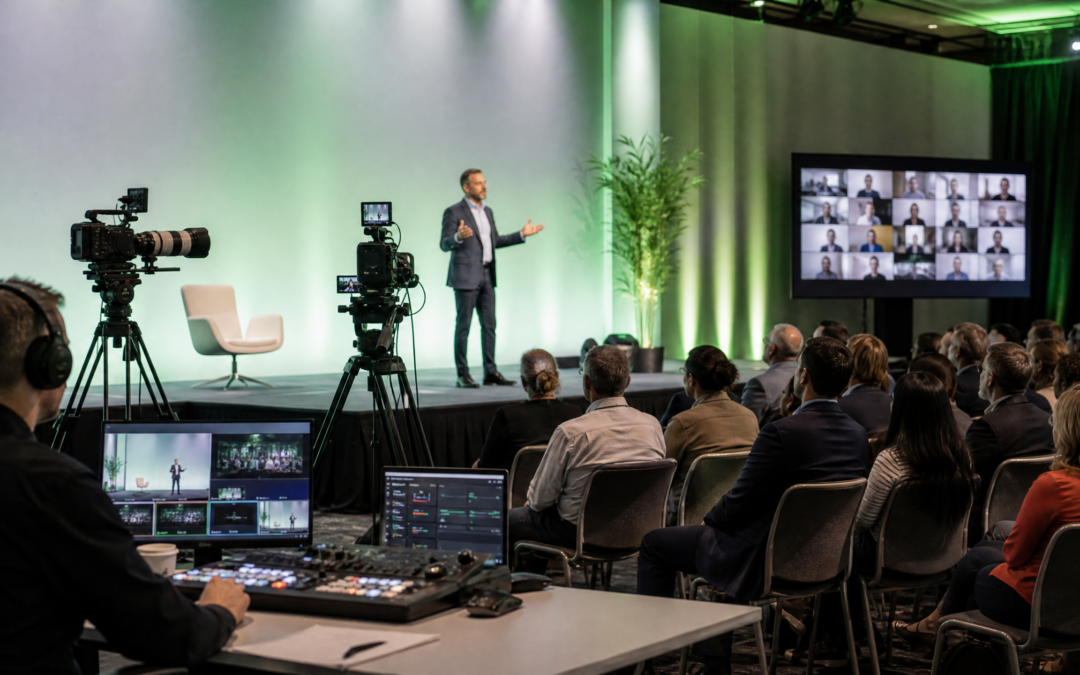
Hybrid Event Production Solutions mean designing one coherent program that serves both a live room and remote participants without duplicating content streams. For corporate event teams this requires treating the program as a single editorial flow while architecting parallel delivery: live staging, camera direction, broadcast-quality encoding, and a remote-first content layer that adapts timing, pacing, and interaction. Production planning must align narrative beats, speaker cues, and technical handoffs so both audiences feel considered. Equally important are moderation workflows, redundancy and accessible captioning. This approach reduces cognitive load for presenters and centralizes production control, letting marketing and internal-communications teams focus on audience journeys, sponsor visibility, and measurable engagement across both channels.
In This Guide
- Hybrid Event Production Solutions: Architecture and Control
- Content Choreography: One Script, Two Journeys
- Technical Workflows and Sync for Dual Delivery
- Audience Experience Design: Parallel Engagements
- Operational Rehearsals and Escalation Paths
Planning an event with high stakes? Book a 30-minute consultation with ICV Digital Media.
Hybrid Event Production Solutions: Architecture and Control
Start by defining a single production architecture that accommodates both room and remote audiences without running separate shows. Use a unified control room that handles camera switching, audio mixing, graphics and streamer outputs with channelized feeds for on-site screens and broadcast encoders. Standardize timecode and tally so stage cues map to streamed segments. Plan camera positions and lens choices to support both cinematic shots for remote viewers and wide ambient shots for the room. Choose a media server or MAM that serves the same assets with tailored encoding profiles. For corporate events integrate sponsor assets and compliance slides at the control layer, ensuring consistent branding and legal messaging across all outputs.
Content Choreography: One Script, Two Journeys
Treat the program editorially as one script with split experiences. Map the core narrative and identify moments that require alternate content — Q&A pacing, poll prompts, breakout cues — then create versioned segments. For example, shorten transitions for remote viewers while allowing richer networking moments in-room. Establish a content call sheet linking speaker slides, lower-thirds, and localized visuals so production can swap assets without interrupting flow. Train speakers on dual-facing presentation techniques: keep eye-lines toward camera during key points and use stage movement intentionally for live energy. Coordinate with comms and legal to pre-approve clips and messaging variants so compliance and sponsor obligations are met across both delivery paths.
Technical Workflows and Sync for Dual Delivery
Technical workflows must prioritize synchronized timing and resilient signal paths. Build redundant encoders and parallel internet links with automatic failover, and route venue house audio through the broadcast chain to prevent divergence between live and streamed mixes. Implement SMPTE or NTP timecode across cameras, playback servers, and lighting consoles to keep branded moments, captions and graphics locked. Automate ingest of presenter slides into the broadcast playout to avoid manual rekeying, and standardize codec and bitrates for archive versus live distribution. Ensure captioning and translation are fed from the same timestamps to preserve context. For Bay Area or Silicon Valley events, validate regional CDNs and enterprise firewall rules early to prevent delivery hiccups for corporate remote viewers.
Audience Experience Design: Parallel Engagements
Design distinct engagement layers that run in parallel to the main program so in-person and remote attendees feel prioritized. For the room, provide tactile networking moments, live demos, and space cues; for remote, surface threaded conversations, moderated Q&A, and micro-breakouts with persistent rooms. Use synchronized triggers so applause, polls, and slide changes register for both audiences, and design transitions that make technical handoffs invisible. Tailor sponsor activations: in-room sampling and remote downloadable assets should map to the same sponsor objectives but be delivered through medium-appropriate mechanics. Measure engagement through platform metrics and on-site behaviors separately, then compare patterns to refine future program pacing and content segmentation.
Operational Rehearsals and Escalation Paths
Rehearsals should cover the single-program workflow end-to-end: stage cues, camera blocking, remote presenter feeds, captioning, sponsor roll-ins, and simulated failures. Run a tech-dress that includes remote participants joining from representative corporate networks to test enterprise VPNs, single-sign-on, and firewall behavior. Establish an escalation matrix with role-based responsibilities — production lead, broadcast engineer, AV operator, remote-moderator — and document decision thresholds for switching to backup encoders or fallback audio paths. Keep a lightweight incident log during rehearsals to capture timing offsets, latency patterns, and human errors. After each run, produce an actionable punch list that the production ops team can close before showtime to reduce last-minute cognitive load on speakers and stakeholders.
Planning Checklist
Use this concise checklist to convert the planning discussion into practical next steps.
- Map the single editorial script and flag segments that require alternate delivery.
- Set up a unified control room with timecode sync and redundant encoders.
- Run a full tech-dress including remote participants on representative corporate networks.
- Document the escalation matrix and close the rehearsal punch list before showtime.
Related Corporate Production Resources
Teams can also review ICV Digital Media’s AV equipment and technical production, locations we serve pages when defining scope, delivery requirements, and technical planning. When the outline is ready, request an estimate to discuss the production approach with an ICV producer.
The ICV Perspective
ICV Digital Media helps corporate teams turn complex programs into clear, broadcast-quality experiences. Our approach brings together production planning, dedicated technical execution, hybrid-event operations, and practical contingency planning so the event can serve both its audience and its business purpose.
Build a More Reliable Event Experience
Talk through your venue, production scope, hybrid workflow, and run of show with an ICV Digital Media producer.