
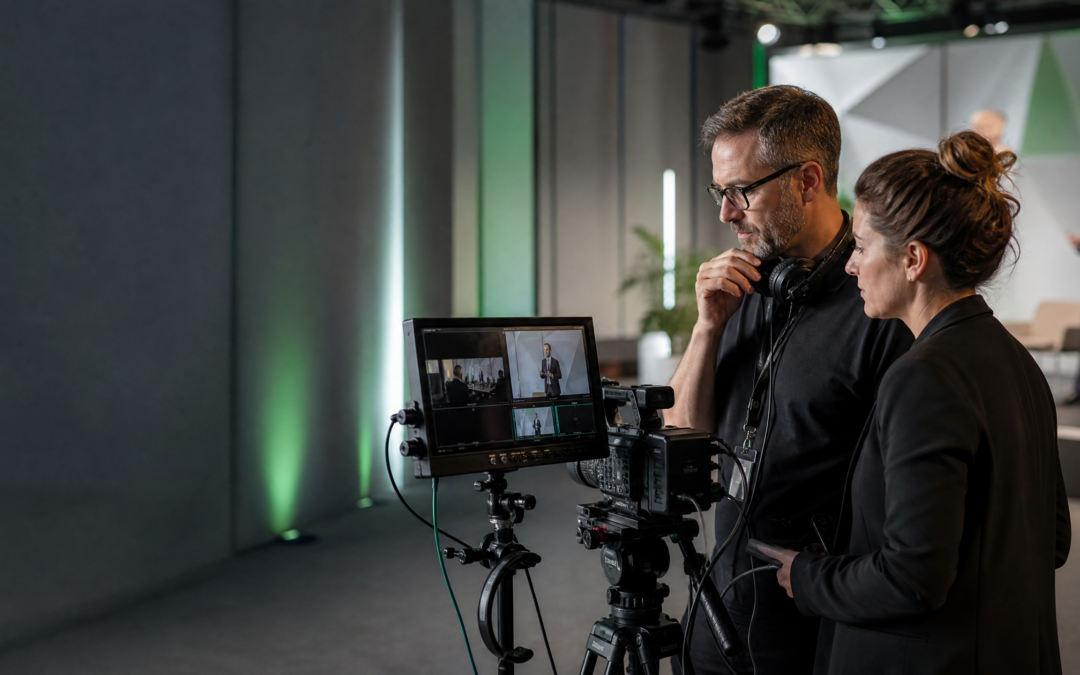
When corporate communications and event teams need to stream executive briefings, product launches, or town halls, selecting the right B2B Live Webcasting Company changes how the program runs and how audiences engage. The decision should be grounded in production workflow, technical coordination, content security, and the vendor’s experience with enterprise integrations. This guide highlights the practical evaluation areas: studio and field production capabilities, encoding and CDN options, platform interoperability with single sign-on and registration systems, monitoring and redundancy plans, and post-event asset delivery and analytics. Focus on vendor processes and technical safeguards to align delivery with corporate policies and audience expectations across global locations.
In This Guide
- How to Evaluate a B2B Live Webcasting Company’s Technical Stack
- Production Workflow: From Preproduction to Live Delivery
- Security, Compliance, and Enterprise Integrations
- Audience Experience, Accessibility, and Interactivity
- Operational Coordination, SLAs, and Vendor Communication
Planning an event with high stakes? Book a 30-minute consultation with ICV Digital Media.
How to Evaluate a B2B Live Webcasting Company’s Technical Stack
Start by inventorying the vendor’s technical stack and how it maps to your program requirements. Confirm camera and encoder support for multi-camera shoots, remote guest contribution codecs, and live-switching capacity. Ask about encoding formats, adaptive bitrate delivery, CDN partners, and monitoring tools that detect stream degradation. Verify support for SRT, RTMP fallback, and low-latency options if interactive Q&A is needed. Confirm recording formats, captioning workflows, and analytics APIs for post-event reporting. Discuss test-stream schedules, rehearsal plans, and documented runbooks that outline failover steps and contact trees. Also review bandwidth requirements for key locations and whether the vendor provides on-site network assessments or recommends dedicated circuits.
Production Workflow: From Preproduction to Live Delivery
Map the vendor’s production workflow to your internal approval and content timelines. Confirm preproduction services such as scripting, shot lists, teleprompter support, slide ingestion, and graphics templates. Ask how rehearsals are run, who controls the live switcher, and how producers coordinate speakers, moderators, and remote contributors. Clarify responsibilities for media playback, slide timing, and lower-thirds insertion. During live delivery, define roles for stream monitoring, audience moderation, and technical escalation. Post-event, verify editing windows for asset turnaround, versioning for different markets, and archival methods. A clear workflow chart and named contacts for each stage reduce ambiguity and speed troubleshooting when production pressure builds. Include signoffs and change-control procedures tied to deliverable dates.
Security, Compliance, and Enterprise Integrations
Corporate broadcasts must align with IT security and compliance requirements. Ask about authentication options such as SSO, tokenized links, and domain-restricted players to control access. Confirm encryption in transit and at rest, retention policies, and whether the vendor supports enterprise DLP or watermarking for sensitive content. Review how user registration data flows into CRM or LMS systems and whether the vendor will sign data processing agreements or adhere to corporate vendor-security questionnaires. Confirm incident response plans, audit logs, and vulnerability scanning cadence. For regulated industries, check support for regional data residency, export controls, and recordkeeping practices. Clear documentation of integrations and security milestones should be part of any proposal.
Audience Experience, Accessibility, and Interactivity
Define the audience experience from landing page to on-demand replay. Review the vendor’s webcast player for responsive design, captioning support, and keyboard navigation to meet accessibility standards. Confirm options for language interpretation, live captions, and post-event transcript delivery. Evaluate interactivity tools—Q&A moderation, polling, whiteboards—and whether they integrate into moderation queues or CRMs for follow-up. Check mobile performance and regional CDN behavior for global audiences. Discuss latency expectations for live Q&A, and whether low-latency delivery requires additional configuration. Finally, review branding controls, registration flows, and email nurture capabilities to ensure the webcast aligns with the corporate experience and downstream communications plans. Request sample replays to test user experience across devices.
Operational Coordination, SLAs, and Vendor Communication
Operational clarity prevents last-minute confusion. Define service-level expectations for stream uptime, start-to-end timing, and recovery windows; include measurables in the contract. Agree on communication channels, escalation paths, and named on-call personnel for rehearsals and event day. Review billing models—flat fee, per-attendee, or add-ons for dedicated encoders or field crews—and ensure change orders are documented. Ask about staffing ratios for producer, technical director, and engineer roles during live events. Confirm rehearsal cadence, dry-run deliverables, and approval gates for creative assets. Finally, require post-event technical reports that include encoder logs, bitrate graphs, and error events so internal teams can evaluate vendor performance against agreed SLAs. Schedule regular vendor performance reviews.
Planning Checklist
Use this concise checklist to convert the planning discussion into practical next steps.
- Inventory technical requirements and run a proof-of-concept stream.
- Schedule a full rehearsal with named vendor contacts and test streams.
- Obtain security documentation, data processing terms, and SSO integration details.
- Include SLAs with measurable uptime and recovery windows in the contract.
Related Corporate Production Resources
Teams can also review ICV Digital Media’s live streaming and webcasting production, locations we serve pages when defining scope, delivery requirements, and technical planning. When the outline is ready, request an estimate to discuss the production approach with an ICV producer.
The ICV Perspective
ICV Digital Media helps corporate teams turn complex programs into clear, broadcast-quality experiences. Our approach brings together production planning, dedicated technical execution, hybrid-event operations, and practical contingency planning so the event can serve both its audience and its business purpose.
Build a More Reliable Event Experience
Talk through your venue, production scope, hybrid workflow, and run of show with an ICV Digital Media producer.